Data validity and characteristics of the participants
The HF data of HRV obtained from 37 participants (20 women and 17 men) aged 21–66 (mean age: 43.6 ± 18.4) years were valid. Among them, 18 were assigned to the older group (9 women, 9 men; 49–66 [mean: 61.2 ± 4.79] years) and 19 to the younger group (11 women, 8 men; 21–48 [mean: 27.1 ± 7.81] years).
The SCL data of 39 participants (21 women and 18 men), who were aged 21–66 (mean: 44.2 ± 18.8) years, were valid. Of them, 20 were included in the older group (10 women, 10 men; mean age: 61.3 ± 4.72 years) and 19 in the younger group (11 women, 8 men; mean age: 26.2 ± 7.42 years).
The DST data of 35 participants (20 women, 15 men), who were aged 21–66 years (mean age: 46.5 ± 18.4 years), were analyzed. The older group included 20 participants (10 women, 10 men; mean age: 61.3 ± 4.72 years), and the younger group comprised 15 participants (10 women, 5 men; mean age: 26.8 ± 8.04 years).
Statistical analyses were conducted using the participant population described above. Outlier tests were performed for each analysis, and the number of participants included in the final analyses varied depending on the results of the outlier screenings. The number of participants who passed the outlier test and were included in each analysis is indicated in the corresponding figures and Supplementary Table S1 online.
Effect of the task condition and age group
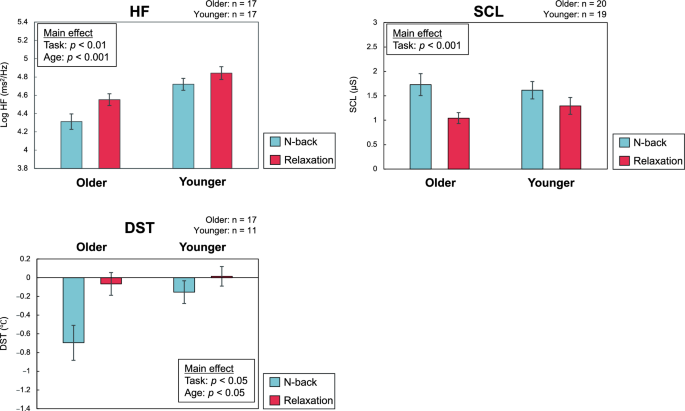
Figure 1 shows the mean values and standard errors (SEs) of the HF, SCL, and DST under the N-back and relaxation task conditions stratified by age group. These data were analyzed to assess the effects of cognitive load and age on ANS function. In this context, higher HF values reflected a greater PNS activity. Meanwhile, higher SCL and lower DST values indicated increased SNS activity.

Mean values of the HF, SCL, and DST for each task condition (N-back and relaxation) across the older and younger groups. The error bars represent the standard error of the mean. A p value less than 0.05 was considered statistically significant. The blue and pink bars correspond to the N-back and relaxation conditions, respectively. The task condition exhibited significant main effects in all indices. In addition, the age group had significant main effects on the HF and DST. No significant interaction effects were observed between the task condition and age group for any of the indices.
The task condition had a significant main effect on all three physiological indices. In particular, the HF in the N-back task condition was significantly lower than that in the relaxation condition (F (1, 32) = 8.76, p = 0.00576), thereby indicating a reduced PNS activity under the cognitive load. In contrast, the SCL was significantly higher in the N-back task condition compared with the relaxation condition (F (1, 37) = 16.5, p = 0.000240), which was consistent with increased SNS activity. Similarly, a significant decrease in the DST was observed during the N-back task condition compared with the relaxation condition (F (1, 26) = 6.47, p = 0.0173), thereby further supporting heightened sympathetic arousal during the cognitive task.
The age group also exhibited main effects. The older group had significantly lower HF values than the younger group (F (1, 32) = 19.03, p = 0.000125), thereby indicating a reduction in baseline PNS activity with aging. A significant age-related difference was found for DST (F (1, 26) = 4.32, p = 0.0477), with the older group having lower values than the younger group, which suggests a higher baseline SNS activity. However, the age group did not have a significant effect on SCL (F (1, 37) = 0.103, p = 0.751), which indicated that the tonic SC did not differ significantly between the age groups.
In contrast, the interaction effects between the task condition and age group were not statistically significant for any of the indices examined. In particular, the interaction terms for HF (F (1, 32) = 0.920, p = 0.345), SCL (F (1, 37) = 2.20, p = 0.146), and DST (F (1, 26) = 2.13, p = 0.157) did not reach statistical significance. Based on these results, although task condition and age independently influenced autonomic responses, the patterns of task-related change were consistent across age groups.
Effect of the sound condition
Figures 2 and 3 present the mean values and SEs of the HF, SCL, and DST under each sound condition (FRS, HCS, and NS) for the N-back and relaxation conditions, respectively. The data of the whole group and the older and younger groups were presented, thereby allowing the examination of the influence of sound condition on SNS and PNS activity.

Mean values of the HF, SCL, and DST during the N-back task condition across the whole group, older group, and younger group. The error bars represent the standard error of the mean. A p value less than 0.05 was considered statistically significant. The blue, pink, and gray bars correspond to the high-cut sound (HCS), full-range sound (FRS), and no-sound (NS) conditions, respectively. For the HF, the significant main effects of the sound condition were detected in the whole and older groups. Post hoc comparisons with Holm’s correction indicated that the HF values were significantly higher in the FRS condition than in the HCS condition (whole group: p = 0.0425; older group: p = 0.0436). For SCL, the significant main effect of the sound condition was observed only in the older group, with higher values observed in the FRS condition than in the HCS condition (p = 0.0410). The sound condition did not have significant main effects on the DST in any of the groups.

Mean values of the HF, SCL, and DST during the relaxation condition across the whole group, older group, and younger group. The error bars represent the standard error of the mean. A p value less than 0.05 was considered statistically significant. The blue, pink, and gray bars correspond to the high-cut sound (HCS), full-range sound (FRS), and no-sound (NS) conditions, respectively. For DST, the significant main effect of the sound condition was observed in the whole group. Post hoc comparisons with Holm’s correction showed that the DST values were significantly higher in the FRS condition than in the HCS condition (p = 0.0100). In the older group, although the main effect of the sound condition did not reach statistical significance, the DST values were more likely to be higher in the FRS condition than in the HCS condition (p = 0.100). The sound condition did not have significant main effects on the HF or SCL in any of the groups during the relaxation condition.
N-Back Task Condition: As shown in Fig. 2, the sound condition had a significant main effect on HF in the whole group (F (2, 62) = 5.53, p = 0.00619) and in the older group (F (2, 26) = 6.56, p = 0.00494). Post hoc comparisons revealed that the FRS and NS conditions had significantly higher HF values than the HCS condition. In particular, in the whole group, the HF in the FRS (p = 0.0425) and NS (p = 0.00260) conditions was significantly higher than those in the HCS condition. However, the HF did not significantly differ between the FRS and NS conditions (p = 0.711). A similar pattern was observed in the older group, where the HF was significantly greater in the FRS (p = 0.0436) and NS (p = 0.00190) conditions than in the HCS condition. Nevertheless, there was no significant difference between the FRS and NS conditions (p = 0.512). The sound condition did not have a significant main effect on HF in the younger group (F (2, 32) = 2.79, p = 0.0763). Thus, the influence of HF sound components may be more evident in older adults than in younger ones.
The sound condition had a significant main effect on the SCL only in the older group (F (2, 34) = 3.36, p = 0.0467). Post hoc analysis showed that SCL in the FRS (p = 0.0410) and NS (p = 0.0230) conditions were significantly higher relative to those in the HCS condition. However, no significant difference was observed between the FRS and NS conditions in terms of the SCL (p = 0.753). In contrast, the sound condition did not have a significant effect on the SCL in the whole group (F (2, 74) = 1.62, p = 0.206) and the younger group (F (2, 36) = 0.423, p = 0.658).
The sound condition did not have significant main effects on the DST in any of the groups. In whole group, the DST did not differ significantly across the conditions (F (2, 60) = 0.0371, p = 0.964). Further, the DST did not have significant effects in the older (F (2, 34) = 0.266, p = 0.768) and younger (F (2, 26) = 1.33, p = 0.281) groups.
Relaxation Condition: As shown in Fig. 3, the sound condition had a significant main effect on the DST in the whole group (F (2, 62) = 6.11, p = 0.00379). Post hoc comparisons showed that the DST was significantly higher in the FRS (p = 0.0100) and NS (p = 0.0200) conditions than in the HCS condition. Meanwhile, there was no significant difference in the DST between the FRS and NS conditions (p = 0.900). In the older group, although the main effect did not reach statistical significance (F (2, 36) = 3.16, p = 0.0542), the DST was more likely to be higher in the FRS condition than in the HCS condition (p = 0.100), thereby suggesting a possible age-related sensitivity. Nonetheless, there were no significant differences in the DST in the younger group (F (2, 22) = 2.79, p = 0.0834).
The sound condition did not have significant effects on the HF during the relaxation condition in any of the groups. The F-values and p values were as follows: whole group, F (2, 70) = 0.0894, p = 0.915; older group, F (2, 32) = 1.33, p = 0.280; and younger group, F (2, 36) = 2.95, p = 0.0649. Similarly, the sound condition did not significantly affect the SCL in any of the groups, as evidenced by the following values: whole group, F (2, 70) = 2.84, p = 0.0652; older group, F (2, 36) = 1.12, p = 0.337; and younger group, F (2, 36) = 0.361, p = 0.699.
link